Hello everyone, if you’ve ever felt confused about your curl type or struggled to find the right products for your hair, you’re not alone. Understanding your curl pattern can completely change how you care for, style, and maintain your curls—and that’s exactly what this guide is about.
Why Knowing Your Curl Type Matters
For a long time, I didn’t even know curl types existed. Once I finally discovered my curl type, everything became easier—styling, understanding my hair, and choosing the right products. Knowing your curl type helps you:
- Understand how your hair behaves
- Choose products that actually work
- Follow routines designed for your hair pattern
- Maintain healthy, defined curls
However, curl type isn’t the only factor. Hair density, porosity, and length also play a huge role. Even two people with the same curl type can have completely different hair. In this blog, we’re focusing only on curl types so you can build a strong foundation.
The Curl Type System Explained
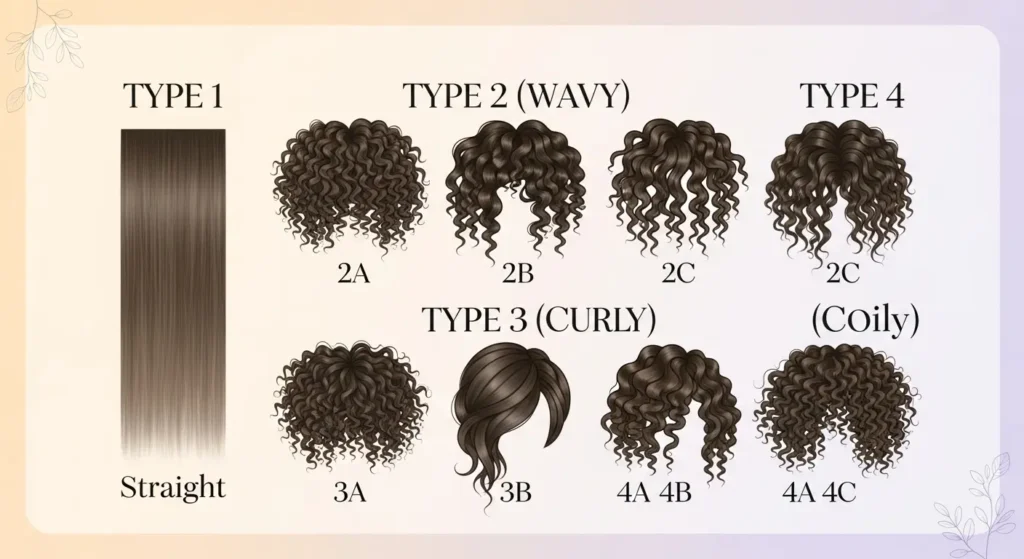
There are four main hair types, and within some of them, there are subcategories:
- Type 1: Straight hair
- Type 2: Wavy hair (2A, 2B, 2C)
- Type 3: Curly hair (3A, 3B, 3C)
- Type 4: Coily / Kinky hair (4A, 4B, 4C)
Type 1 Hair: Straight Hair
Type 1 hair is completely straight with no wave, curl, or kink. Since this guide focuses on curls, we’ll move right along.
Type 2 Hair: Wavy Hair
Type 2 hair sits between straight and curly and is defined by an “S” shape.
2A – Loose Waves
Very light waves
Minimal definition
Beachy texture
Slight volume compared to straight hair
2B – Defined Waves
- More noticeable wave pattern
- Clear “S” shape
- Still no ringlets or curl
2C – Strong Waves
- Deep, prominent “S” shape
- Some strands may start curling
- More texture and body
Best Styling Tip for Type 2 Hair:
Use lightweight leave-in conditioners, gels, and moisturizers. Avoid heavy products. Apply products to soaking wet hair to enhance waves and define the natural pattern.
Type 3 Hair: Curly Hair
This is where true curls begin—and where many people (including me) fall.
3A – Loose Curls
- Large, loose ringlets
- Soft curl pattern
- Less volume compared to tighter curls
3B – Defined Ringlets
- Well-defined spirals
- Medium-sized curls
- Can achieve great volume with the right cut
- This is my curl type
3C – Tight Curls
- Tight, springy spirals
- High volume
- Curls grow upward rather than falling down
- Pencil-sized ringlets
It’s very common to have a mix of curl types, such as 3A and 3B or 3B and 3C.
Best Products for Type 3 Hair:
- Leave-in moisturizers
- Mousses for volume and hold
- Gels for definition
- Avoid very heavy butters for 3A and 3B hair, as they can weigh curls down. Heavier products work better for 3C hair.
Can You Manipulate Curly Hair?
Yes—especially with 3A and 3B hair. When brushed wet, curls may look straight, but they will curl back up as the hair dries. This doesn’t mean you don’t have curls or that scrunching “creates” them. The curl pattern is always there—it just takes time to form.
Type 4 Hair: Coily and Kinky Hair
Type 4 hair is the most textured and coarsest hair type.
- Zigzag or tight coil pattern
- Incredible shrinkage
- Very dense and thick
- Afro-textured hair
Type 4 hair needs a lot of moisture and care. Thicker products like butters, creams, and rich moisturizers work best to keep the hair healthy and hydrated.
Why Curl Categories Are Helpful
Knowing your curl type helps you:
- Find people with similar hair
- Choose products more confidently
- Follow routines designed for your curls
While not every product will work perfectly, curl typing gives you a strong starting point.
There are also online quizzes and tools that can help estimate your curl type and recommend products based on your hair needs.
Final Thoughts: Every Curl Is Unique
Not all curls bounce up immediately after washing. Some take longer to form, and many people have multiple curl types on one head of hair—and that’s completely normal.
Understanding your curl type empowers you to care for your hair with confidence.
Let’s Talk Curls 💬
Comment your curl type below and share any tips you have! It’s so helpful to learn from others with similar hair patterns. Whether you’re wavy, curly, or coily—every curl is beautiful.
Thank you for reading, and I hope this guide helped you understand your curls a little better 💛
More Curl Tips You’ll Love
https://curlsexpression.com/a-simple-no-stress-curly-hair-routine-that-actually-works/